


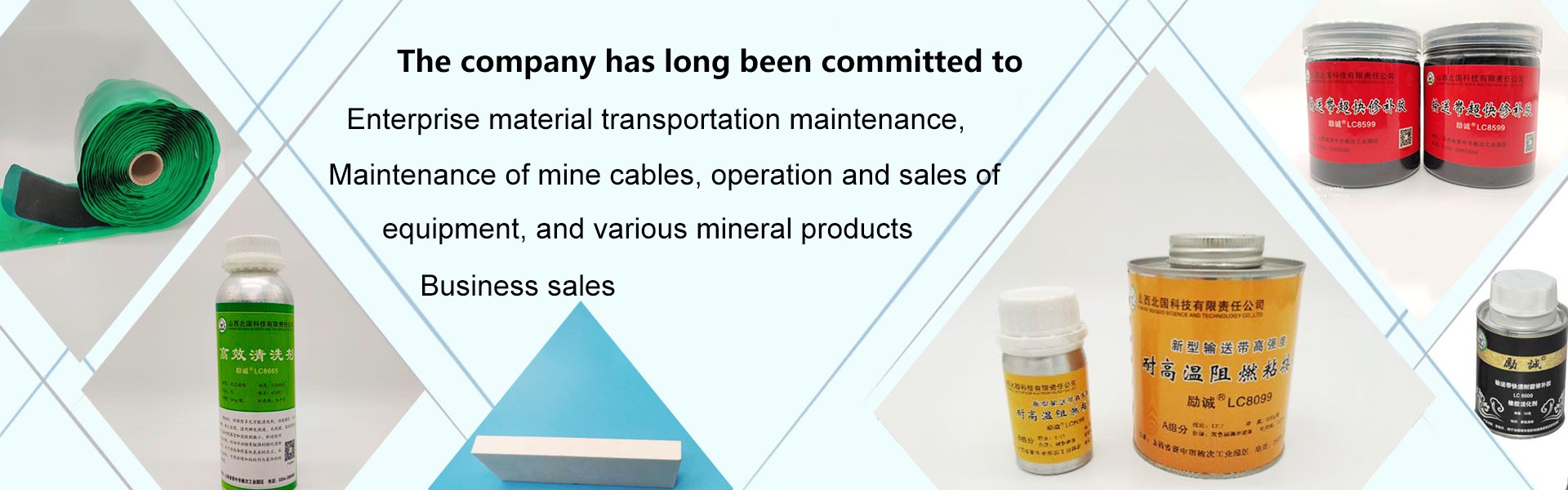
- Industry
-
Industry Applications
-
Application in the coal industry
-
Application in Mineral Processing Industry
-
Application in coking industry
-
Application in the power industry
Contact Us
Shanxi Beiguo Science And Technology Co., LTD
Business Consultation:+86-0354-3965688
Address: Yuci Industrial Park, Jinzhong City, Shanxi Province
The principle and application of adhesive
Release time:2019-10-29
What is adhesive? What are the principles and uses of adhesives?
Adhesive bonding refers to the technique of connecting surfaces of homogeneous or heterogeneous objects together using adhesive. It has the characteristics of continuous stress distribution, light weight, or sealing, and mostly low process temperatures. Adhesive bonding is particularly suitable for connecting different materials, thicknesses, ultra-thin specifications, and complex components.
A natural or synthetic, organic or inorganic substance that can connect two or more components or materials together through adhesion and cohesion at the interface, collectively referred to as adhesive, also known as glue, commonly abbreviated as glue. In short, adhesive is a substance that can bond objects together through adhesive action. Adhesive "is a universal standard term.
Adsorption theory
The theory that regards the adsorption of solids on adhesives as the primary element of bonding is called the adsorption theory of bonding. The theory suggests that the primary source of adhesive force is the molecular forces of the bonding system, namely van der Waals attraction and hydrogen bonding. The adhesive force and adsorption force on the surface of the adhesive and the adhered object have some similar properties. The interaction process between adhesive molecules and surface molecules of the adhered object has two stages: the first stage is when liquid adhesive molecules disperse towards the surface of the adhered object through Brownian motion, bringing polar groups or chain links at the two interfaces closer to each other. During this process, heating up, applying touch pressure, and reducing adhesive viscosity all contribute to the strengthening of Brownian motion. The second period is the onset of adsorption force. When the distance between the adhesive and the adhered molecules reaches 10-5, the interface molecules will exert mutual attraction, further shortening the distance between the molecules to a maximum stable state.
The adhesive strength differs greatly from theoretical calculations because the mechanical strength of solids is a mechanical property rather than a molecular property, and its size depends on the properties of each part of the data, rather than the sum of molecular forces. The calculation value assumes that two ideal planes are in close contact and ensures that when the interaction between each pair of molecules on the interface layer is damaged together, it is impossible to ensure that the forces between each pair of molecules act simultaneously.
The polarity of the adhesive is too high, which sometimes severely hinders the wetting process and reduces the adhesive strength. The intermolecular forces are the elements that supply the adhesive force, but not just the elements. In certain exceptional circumstances, other factors can also play a dominant role.
Chemical Bond Formation Theory
The chemical bond theory holds that in addition to the interaction between adhesive and the adhered molecules, there are sometimes chemical bonds that occur, and the strength of chemical bonds is much higher than that of van der Waals forces; Chemical bonding not only enhances adhesion strength, but also overcomes the drawbacks of detachment and damage to adhesive joints. However, the composition of chemical bonds is not ordinary, and it is necessary to satisfy certain conditions in order to form chemical bonds. Therefore, it is impossible to achieve chemical bonds at all touch points between the adhesive and the adherend. Moreover, the number of chemical bonds on the unit adhesion interface is much smaller than the number of intermolecular interactions, so the adhesion strength derived from intermolecular forces cannot be ignored.
Weak boundary layer theory
When liquid adhesive cannot effectively moisturize the surface of the adhered object, air bubbles remain in the open space, forming a weak zone. For example, if impurities are soluble in the molten adhesive but insoluble in the solidified adhesive, another phase will form in the solidified adhesive, resulting in a weak interfacial layer (WBL) between the adhesive and the adhesive as a whole. In addition to skill elements, the occurrence of WBL occurs due to the non-uniformity of interfacial layer structure in thermodynamic phenomena such as adhesive and surface adsorption during the formation process of polymer networks or melt interactions. The uneven interface layer will exhibit WBL. The stress relaxation and crack propagation of this WBL will be different.
Dispersion theory
Under compatible conditions, when two polymers come into close contact with each other, they disperse due to the Brownian motion of molecules or the swinging of chain segments. This dispersing effect occurs by crossing the interface between the adhesive and the adhered material. The dispersed effect leads to the disappearance of the interface and the onset of transition zones. The adhesive system cannot explain the adhesion between polymer materials and metals, glass, or other hard objects based on dispersion theory, as polymers are difficult to disperse into such materials.
Electrostatic theory
When the adhesive and the adherend system are a combination of electron acceptor donor, electrons will transfer from the donor (such as metal) to the acceptor (such as polymer), forming a double layer on both sides of the interface region, and then electrostatic attraction will occur. However, although electrostatic forces do exist in certain exceptional bonding systems, they are by no means the dominant factor.
Mechanical force theory
From the perspective of physical chemistry, mechanical action is not the element that triggers adhesive force, but rather a method of adding adhesive force. The adhesive penetrates into the gaps or high and low areas on the surface of the adhered object, and after curing, it exerts a meshing force in the interface area, similar to the bonding between nails and wood or the effect of tree roots implanted in soil. The essence of mechanical connection force is frictional force. When bonding, arranging the connection force is crucial, but for certain solid and lubricated surfaces, this effect is not significant.
Extension: PP polypropylene material surface bonding substrate and adhesive bonding solution
Polypropylene (PP) material is a non-polar and surface insensitive material with high inertness, making it difficult to bond on the surface. In actual surface bonding processes, there is often a phenomenon of weak adhesion and delamination. Generally, when bonding polypropylene (PP), it is necessary to use a mixture of adhesive primer and PP glue to achieve a firm bonding effect. Zero halogen has passed RoHS testing and is widely used in the bonding and flocking process of PP material automotive interior parts.
